

Optimising sludge dewatering starts with reliable measurement
The dewatering machine is running, sludge cake is coming out, and the centrate water is flowing away. The process seems to be going well. Nevertheless, questions remain about how well your sludge dewatering process is actually performing. Are you using more polymer than necessary? Does the sludge cake still contain too much water? And how many solids are lost with the separated water?
Anyone looking for an answer to this will always arrive at the same parameter: the dry solids content. Continuous dry solids measurement gives you greater insight into the composition of the sludge. This allows you to recognise changes more quickly and adjust the dewatering process more precisely. For a complete picture, you should also examine the sludge cake and the separated water.

Why the dry solids content carries so much weight
Wastewater enters the treatment works highly diluted. In a series of tanks, it is thickened step by step until a sludge remains that is thick enough for the dewatering machine. The goal is to obtain a sludge cake that is as dry as possible.
To make it easier to extract water from the sludge, a polymer is added. This causes the sludge particles to clump together and separate more readily from the water. In practice, everything revolves around the right quantity, which depends directly on the dry solids content of the sludge entering the machine.
If you miss this correct dose, you will notice it in two places: in your costs and in the quality of your centrate water.
- Polymer consumption: polymer is an expensive raw material, so every unnecessary dose adds to your operating costs.
- Sludge processing: the wetter the sludge cake, the more water you are sending to be incinerated.
- Centrate quality: polymer is poorly biodegradable. Any unbound polymer that goes with the centrate water will eventually end up in surface water.
Every litre of water you send to the incinerator costs money.
Maarten van der Voordt
Dry Solids Measurement Expert at Elscolab

Optical or microwave: what does a dry solids meter actually see?
The target is a sludge cake with more than 30 percent dry solids. To achieve this dry sludge cake, you need to know what is going into the machine. Therefore, the dry solids content is measured inline, just before the dewatering machine. Based on this measurement, you adjust both the polymer dosing and the speed of the machine. However, not every dry solids measurement works in the same way.
Classic optical sensors rely on the colour of the sludge. This works well as long as the composition remains stable. If it changes, the sensor must be recalibrated, a task for which operators in practice often have no time. Moreover, such a sensor measures at a single point in the pipe.
The Valmet total solids analysers we offer work with microwave technology. A microwave signal travels more slowly through the sludge the more water it contains. This relationship is linear, allowing you to measure dry solids inline up to 50 percent. In addition, we use multi-point calibration. The meter is calibrated to multiple reference values rather than just one. The more calibration points, the more accurate the measurement.

Stricter discharge requirements from 2027
Accurate dry solids measurement yields immediate benefits, and its importance will only grow in the coming years. From 2027, the Kaderrichtlijn Water (Water Framework Directive) will impose stricter requirements on discharged water. This gives sludge dewatering an extra dimension. After all, a more efficient dewatering process also yields cleaner centrate water.
For water treatment operators and industrial companies with their own treatment facilities, dry solids measurement thus represents a double win. Your process runs more efficiently, and you take a step towards the environmental standards of tomorrow.

Advice for your installation
Every installation requires a unique approach, which is why Elscolab starts with an on-site visit. We assess whether dry solids measurement is applicable, determine a suitable measurement position, and evaluate the potential savings.
Would you like to know if your sludge dewatering process is running optimally, or what an inline dry solids measurement could yield for your installation? Contact our team to discuss your application.
-
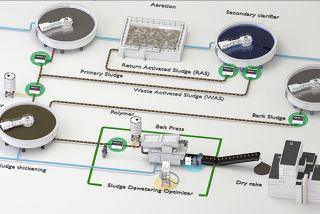
The dewatering of sludge is becoming increasingly important as the costs of transporting and burning dry matter are rising. Discover all possibilities!
-
-


