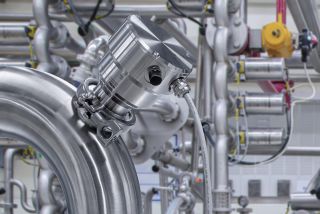
Case study: Time savings through inline monitoring of homogenisation and osmolality

How can you be sure your batch is fully homogeneous?
In buffer and media preparation within the (bio)pharmaceutical industry, pH, conductivity and osmolality are key process parameters. However, these measurements do not always provide insight into the total concentration of dissolved substances or indicate the exact moment when all components are fully dissolved.
Inline refractometry provides a valuable addition. By measuring the Refractive Index (RI), it continuously monitors the total concentration of dissolved components. This gives you additional insight into homogenisation, process stability and batch consistency, without having to wait for additional laboratory results.
In this case study, you will discover how a leading (bio)pharmaceutical company integrated inline refractometry alongside existing pH, conductivity and osmolality measurements to gain greater process insight and improve the efficiency of buffer preparation.
What will you learn in this case study?
- how to determine the exact moment when all components are fully dissolved;
- how inline refractometry monitors the total concentration of dissolved substances;
- why the refractive index shows a strong correlation with offline osmolality measurements;
- how to use a process “fingerprint” to monitor every process step and improve batch-to-batch consistency;
- how real-time process insights contribute to a more efficient production process;
- why inline refractometry is a reliable, low-maintenance PAT technology.
-

Quality and purity are the main concerns during media preparation in the pharma. Ensure a good result by using the right inline measurements.
-
-

Discover how you increase efficiency, improve production quality and save time with a K-Patents inline refractometer for Pharmaceuticals and Biotechnology!


Newsletter
Related blog items